

Stretch Mark Camouflage Tattoo Explained
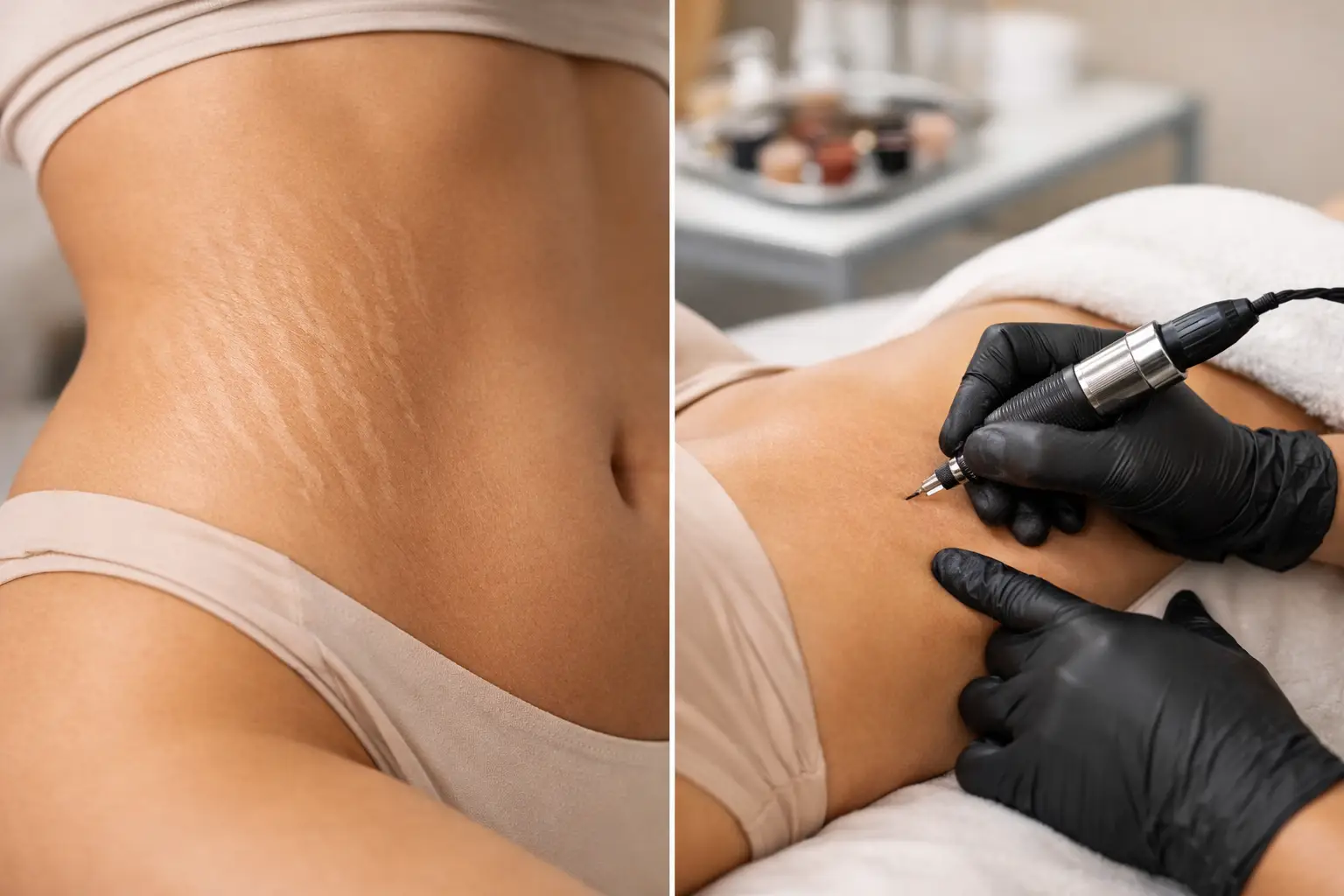
Stretch mark camouflage tattoo is not a trend treatment for people who want a quick cosmetic fix. It is a specialist paramedical procedure designed to reduce the visible contrast between stretch marks and the surrounding skin, so they draw less attention in day-to-day life. When it is done well, the goal is not to erase texture or promise flawless skin. The goal is to create a more balanced appearance that restores confidence and looks believable on real skin.
That distinction matters because stretch marks are complex. They can vary in colour, depth, width, age and texture, and those variables directly affect what can be achieved. A white, mature stretch mark on the stomach after pregnancy behaves differently from a pink, newly formed mark on the hips, and neither should be approached with a one-size-fits-all method. Specialist assessment is what separates realistic improvement from poor pigment work.
What a stretch mark camouflage tattoo actually does
A stretch mark camouflage tattoo uses carefully selected pigment implanted into the affected area to blend the lighter stretch mark closer to the surrounding skin tone. It is a colour correction treatment rather than a decorative tattoo. The purpose is to soften contrast so the eye is less drawn to the mark.
This treatment is usually most effective on mature stretch marks that have already settled into a pale or silvery tone. These marks tend to be more stable, which makes colour matching safer and more predictable. Fresh red, purple or inflamed stretch marks are generally not suitable because the skin is still changing. Tattooing unstable tissue too early can lead to disappointing results and uneven healing.
Texture is another important point. Camouflage tattooing can improve how visible a stretch mark looks, but it does not remove indentations or raised tissue in the way people sometimes expect. If the area has significant textural change, a specialist may recommend combining approaches or treating the skin first to improve the surface before pigment is considered.
Who is suitable for stretch mark camouflage tattoo?
Suitability depends on the condition of the skin, not just the fact that stretch marks are present. The best candidates usually have stretch marks that are fully healed, lighter than the surrounding skin, and stable in appearance. The surrounding skin should also be in good condition, with no active irritation, infection or barrier damage.
Skin tone matters too, but not in the simplistic way many people assume. Stretch mark camouflage tattoo can be performed across a wide range of skin tones, but the practitioner must understand undertones, healing behaviour and pigment selection in depth. Poor colour theory is one of the fastest ways to create visible mismatch. This is why advanced paramedical expertise matters far more than finding a general tattooist or beauty therapist offering the treatment as an add-on.
It may not be suitable if you are pregnant, prone to certain forms of scarring, managing active skin conditions in the area, or hoping to treat newly formed marks. Clients planning significant sun exposure or using strong skin actives may also need to wait. A proper consultation should never rush past medical history, skin behaviour and expectations.
Why mature stretch marks respond better
Mature stretch marks have completed most of their natural healing process. Their colour is more settled, inflammation has reduced, and the practitioner can assess the true contrast that needs correcting. That makes pigment selection more precise and results more consistent.
By contrast, early stretch marks are still evolving. Their colour can shift over time, and the surrounding tissue may continue to change. Treating them too soon can mean the colour chosen no longer makes sense a few months later.
The consultation is where good results begin
The most underestimated part of this treatment is the assessment stage. A specialist consultation should look closely at skin tone, undertone, scar maturity, texture, lifestyle, medical factors and previous treatments. It should also cover what camouflage can and cannot do.
This is the point where honest clinics separate themselves from sales-led providers. Not every stretch mark should be tattooed. In some cases, techniques such as MCA inkless needling, radiofrequency microneedling or a staged treatment plan may be the better route before any pigment is implanted. If the skin quality is poor, trying to camouflage too early can compromise both retention and appearance.
An experienced clinic will also explain that colour is often built gradually. One session may improve visibility, but multiple sessions are common to refine blending and allow the skin to heal between appointments.
What happens during the treatment
After the treatment plan is confirmed, the practitioner will work with custom pigment matching designed for your skin tone. The pigment is implanted into the stretch mark area using a controlled technique intended to diffuse contrast rather than create blocks of flat colour. Precision matters. The area needs to blend with the surrounding skin in different lighting conditions, not just immediately after the appointment.
The treatment itself is usually manageable, although sensation varies by area and individual tolerance. Some clients describe it as mildly uncomfortable rather than painful. The skin may look more obvious straight afterwards due to temporary redness, and the implanted colour can appear stronger before it settles.
Healing takes patience. As the skin recovers, the shade softens and the final result becomes clearer over the following weeks. This is one reason experienced practitioners avoid overpromising on the day of treatment. Immediate appearance is not the final outcome.
Healing, aftercare and why results can vary
Healing is not passive. Aftercare has a direct effect on pigment retention and skin quality. The area usually needs to be kept clean, protected from friction, and shielded from sun exposure while it recovers. Picking, excessive sweating, harsh products and premature tanning can all interfere with the result.
Even with excellent treatment, stretch mark camouflage tattoo is not identical on every client. Skin thickness, immune response, location on the body, age of the marks and previous treatments can all influence retention. The stomach, thighs, breasts and hips do not always heal in the same way.
Sun exposure is a long-term factor too. Because surrounding skin can tan and change depth of colour, camouflage that looks beautifully blended in winter may look slightly different after strong summer sun. That does not mean the treatment has failed, but it does mean maintenance and realistic expectations are part of the conversation.
How long does it last?
Results are long lasting, but they are not always permanent in the way decorative tattoos are often assumed to be. Fading can happen over time, and some clients need top-up sessions to keep the blend looking at its best. Lifestyle, skin regeneration and UV exposure all play a part.
For most clients, that trade-off is worthwhile. The aim is not a static painted-on effect. It is a natural-looking reduction in visibility that still respects the movement and behaviour of real skin.
The biggest misconception about stretch mark camouflage tattoo
The biggest misconception is that it removes stretch marks. It does not. It camouflages them. That difference is not semantic – it is the basis of ethical treatment planning.
A specialist practitioner should be very clear about this. If the marks are deeply indented, very broad, newly formed or inconsistent in tone, the result may be improvement rather than near invisibility. That can still be life-changing for the right client, but only when expectations are set properly.
This is also why training standards matter so much in this field. Stretch mark camouflage sits within advanced paramedical tattooing, where skin knowledge, scar behaviour, pigment science and correction strategy all intersect. Clinics and educators shaping this category in the UK have raised standards by integrating techniques refined in Brazil, the USA and the UK rather than relying on oversimplified methods.
Choosing the right specialist
If you are considering treatment, focus less on price and more on evidence of specialism. This is not an area for generalists. You want a practitioner who understands scar and stretch mark tissue, works confidently across different skin tones, and can explain why they are recommending pigment, needling, staged skin preparation, or a combination approach.
Before-and-after images should show healed results, not only fresh treatment photos. Consultation should feel clinical, detailed and honest. If someone promises complete removal, treats brand new stretch marks, or dismisses the role of texture, that is usually a warning sign.
For practitioners entering this field, the same standard applies. Stretch mark camouflage is a high-value service, but it demands more than equipment and pigment. Proper education, supervised practice and a strong understanding of contraindications are essential if you want safe, consistent outcomes.
At its best, stretch mark camouflage tattoo offers something more meaningful than cosmetic coverage. It gives people a way to feel less defined by visible skin change, while respecting the limits of what the skin can realistically do.
