

Scalp Micropigmentation for Women Explained
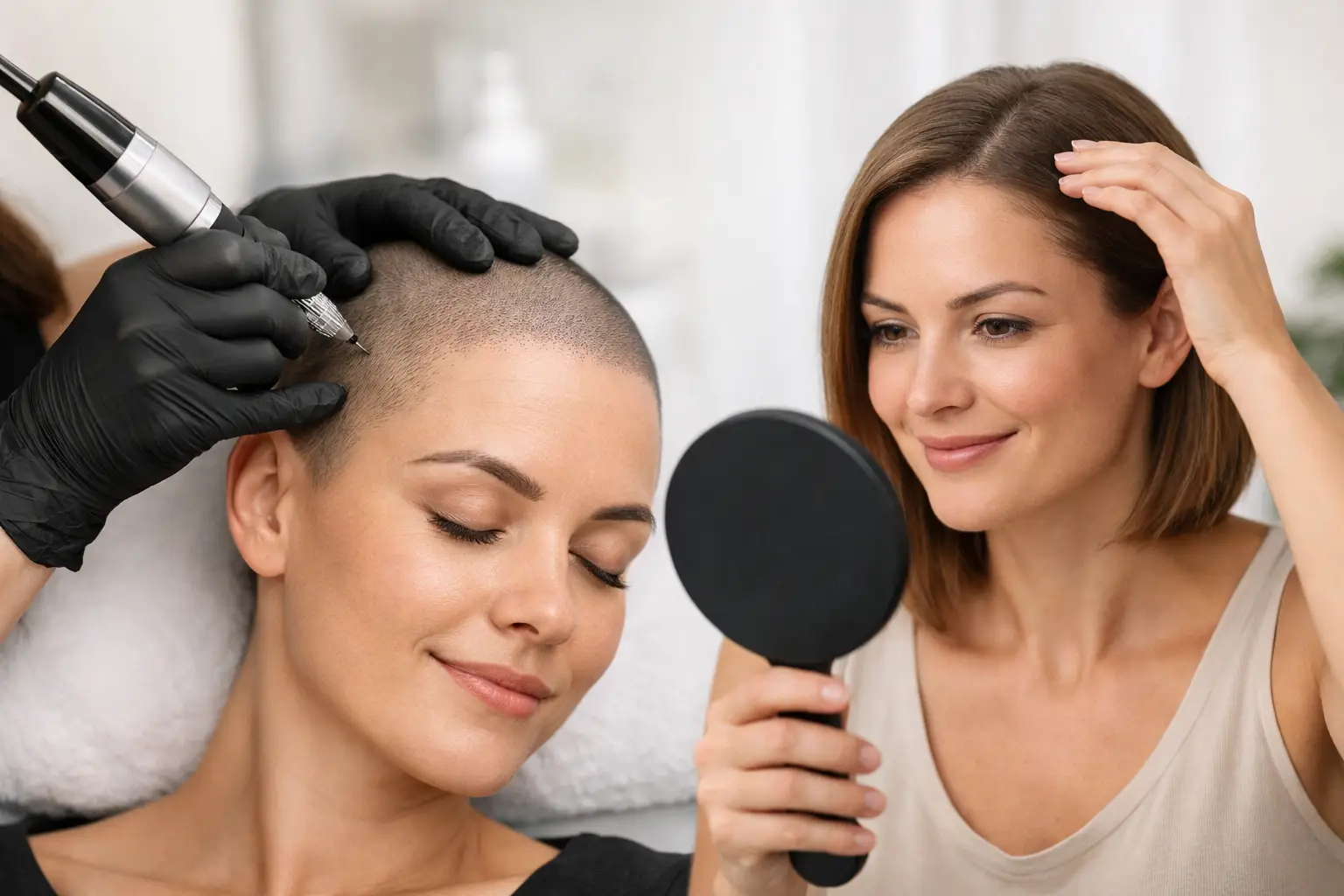
Hair thinning rarely arrives with much warning. One day your parting looks a little wider under bathroom lighting, and a few months later you are changing hairstyles, avoiding overhead photos, and noticing how much of your scalp shows at the crown. For many clients, scalp micropigmentation for women offers a realistic way to reduce that contrast, recreate the look of fuller density, and feel less exposed without surgery.
This is not a treatment designed to create strands of hair. It is a highly specialised form of cosmetic tattooing that uses carefully placed pigment impressions to reduce the visibility of the scalp through thinning areas. When performed properly, the result is subtle. The eye reads less scalp show-through, the hair appears denser, and the overall frame of the face feels more balanced.
What scalp micropigmentation for women actually does
Female hair loss usually presents differently from male pattern baldness. Many women still have hair across the scalp, but it becomes finer, more diffuse, or less dense around the parting, temples, hairline, or crown. That matters because the treatment approach needs to be different.
Scalp micropigmentation for women is usually a density treatment rather than a shaved-head effect. The goal is to replicate the appearance of natural shadow between existing hairs, matching pigment depth, tone, and placement to your hair colour, skin tone, and pattern of thinning. In practical terms, that means making the scalp less noticeable so the remaining hair looks fuller.
A good practitioner is not simply placing dots into the skin. They are assessing light reflection, contrast, the direction of your styling, the scale of the thinning, and how pigment will heal over time. This is where specialist experience matters, particularly for women with diffuse loss, scar tissue, or more complex scalp conditions.
Who it can help
This treatment can be effective for women experiencing genetic thinning, post-partum loss, traction alopecia, thinning linked to hormonal changes, or visible areas after certain medical and cosmetic procedures. It can also help soften the appearance of some scars on the scalp, provided the tissue is suitable to treat.
That said, not every case is straightforward. Active scalp inflammation, certain dermatological conditions, or unstable patterns of shedding may mean treatment should be delayed or approached more cautiously. If a client is in the middle of rapid hair loss, the treatment plan may need to account for how the area could change over the coming months.
This is one reason specialist consultation matters. The best outcomes come from treating the right candidate, on the right tissue, with a design that still makes sense as the hair evolves.
Why women often hesitate before booking
Many women assume scalp micropigmentation is only for men with shaved heads. Others worry it will look obvious, too dark, or artificial under daylight. Those concerns are understandable, especially when the wrong technique has been used in the market and left heavy, flat, or poorly matched results.
Female SMP should be discreet. It should sit within the hair, not compete with it. Pigment selection needs a refined eye, because matching a brunette root shadow is very different from placing a standard dark carbon tone into the scalp. The treatment should also respect softness at the hairline and crown. Women rarely want a hard, graphic edge. They want believable density.
The other hesitation is emotional. Hair loss in women is often minimised publicly and felt very privately. Clients may have spent months covering areas with fibres, powders, sprays, extensions, or strategic styling. By the time they enquire, they are usually not looking for a beauty trend. They are looking for normality.
The treatment process and what to expect
A proper consultation should assess your scalp, medical history, hair colour, degree of thinning, and treatment goals. Your practitioner should explain what SMP can improve and what it cannot. If someone promises to give you a full head of hair, that is a red flag. The treatment creates the illusion of density. It does not reverse the cause of hair loss.
Most cases require a course of sessions rather than one appointment. This layered approach allows the practitioner to build depth gradually, monitor healing, and keep the result soft and controlled. Starting too dark is one of the fastest ways to create a heavy or unnatural finish.
During the treatment, tiny impressions of pigment are implanted into the upper dermal layer using specialist equipment and technique. Discomfort levels vary, but many clients find it manageable. Some areas may feel more sensitive than others, particularly around the temples or scar tissue.
Healing is usually straightforward, though aftercare matters. The scalp needs time to settle, and pigment will often appear slightly stronger immediately after treatment before softening as it heals. Final results should be judged once the area has fully recovered between sessions.
Results, longevity and realistic expectations
One of the strongest benefits of SMP is that the result is immediate in visual terms. As soon as scalp contrast is reduced, the hair often appears fuller. That can be especially effective around the parting line and crown, where light reflection tends to exaggerate thinning.
Longevity depends on factors such as skin type, sun exposure, pigment choice, immune response, and aftercare. Some clients retain their result well for several years before requiring a refresh, while others may need earlier maintenance to keep the colour crisp and balanced.
There is also an important trade-off to understand. Softer, more natural work may fade more gracefully, but it often relies on restraint and layering rather than intense saturation. That is usually a good thing aesthetically. The aim is elegance and realism, not maximum darkness on day one.
Choosing the right practitioner
Scalp work sits at the intersection of aesthetics, technical tattoo knowledge, and skin understanding. For women, this becomes even more nuanced because the treatment is often being performed through existing hair, across varying densities, and sometimes over fragile or compromised tissue.
You should be looking for clear healed results, not just fresh treatment photos. Ask whether the practitioner has experience with female pattern thinning specifically, not just traditional male SMP. Ask how they approach skin tone, scar tissue, hairline softness, and long-term fading.
This is particularly important in a specialist field like paramedical and restorative tattooing, where outcomes depend on much more than machine technique alone. Clinics with deeper expertise in skin repair and camouflage work tend to understand tissue behaviour, healing variables, and colour adaptation at a higher level. That level of judgement matters.
When scalp micropigmentation works best alongside other options
SMP is not an either-or decision in every case. Some women combine it with medical hair loss management, topical or oral treatments prescribed by a clinician, PRP, styling changes, or extensions. Others choose it because they do not want surgery, cannot have surgery, or are tired of temporary concealment products.
It can also be used strategically. A client may not want the entire scalp treated, but may benefit from soft reinforcement at the front hairline, along a widened parting, or through the crown where the scalp catches the light most strongly. In these cases, less often does more.
For women with scarring from surgery or trauma, a broader restorative plan may be needed. Ink Illusions works within that specialist space, where scalp treatment is considered in relation to skin condition, scar maturity, and the overall visual outcome rather than as a one-size-fits-all service.
Is it worth it?
For the right candidate, yes. Not because it replaces hair, but because it changes what people notice first. Instead of seeing scalp, they see shape, density, and balance. That shift can be significant.
The value is not only cosmetic. It is practical. Less time spent disguising thinning. Less dependence on fibres and powders. Less anxiety about bright lighting, wet hair, wind, or photographs from above. Those are the moments that tend to matter most to clients.
If you are considering scalp micropigmentation for women, the key is not rushing into treatment. The quality of the assessment, the subtlety of the design, and the experience behind the handpiece will determine whether the result looks like good work or simply looks like your hair has more presence again.
That is the standard worth holding out for.
