

Best Treatments for Old Scars Explained
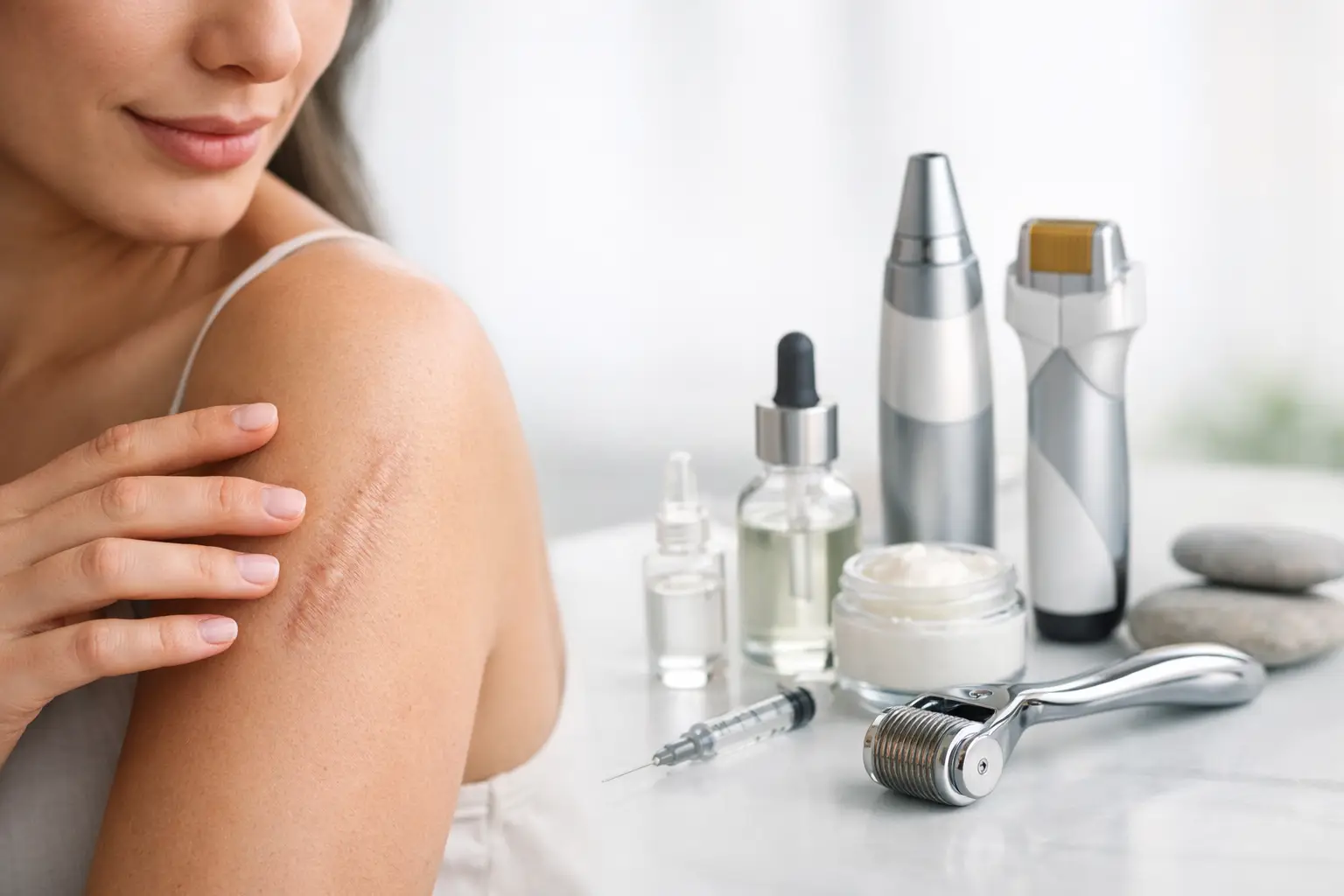
Some old scars fade into the background. Others stay raised, indented, pale, dark or tight for years, long after the skin has healed. When clients ask about the best treatments for old scars, the real answer is not one treatment but the right treatment for the scar’s type, age, colour, texture and location.
That matters because an old surgical line behaves very differently from acne scarring, a burn scar, a C-section scar or mature stretch marks. The wrong approach can waste time and money. The right one can soften texture, improve colour mismatch and make a scar far less noticeable in day-to-day life.
What actually makes an old scar hard to treat?
A mature scar is not simply skin that has healed badly. It is structurally different tissue. Collagen may be disorganised, blood supply may be reduced, pigment cells may be missing or overactive, and the surface may sit higher or lower than the surrounding skin.
This is why old scars often need more than a standard facial or one-off skin treatment. Some need collagen remodelling. Some need colour restoration. Some need controlled resurfacing. Others respond best to a combined plan carried out in stages.
In specialist scar revision work, the first question is not how old the scar is, but what remains to be corrected. Is the main issue redness, hypopigmentation, hyperpigmentation, tethering, shine, thickness or texture? Once that is clear, treatment selection becomes much more precise.
Best treatments for old scars by scar concern
Microneedling and RF microneedling for texture change
If an old scar is indented, uneven or stiff, microneedling is often one of the most useful starting points. By creating controlled micro-injury, the skin is encouraged to produce new collagen and remodel existing scar tissue. Over time, that can improve surface irregularity and soften the feel of the scar.
Radiofrequency microneedling takes that concept further by delivering heat into the deeper layers as the needles penetrate. This can be particularly helpful for thicker or more resistant scarring where texture and firmness are the main concern. It is often chosen for surgical scars, some trauma scars and certain acne scars.
The trade-off is that results are gradual, and one session is rarely enough. Most clients need a course. It is also not the first choice if the scar is mainly a colour mismatch rather than a textural issue.
MCA inkless needling for scar revision
MCA inkless needling is widely used in advanced scar work because it focuses on encouraging regeneration without placing pigment into the skin. For mature scars that are pale, shiny or visibly different in texture from the surrounding area, it can help improve the overall quality of the tissue.
This technique is especially relevant when the goal is to prepare a scar before camouflage tattooing or to improve the skin where traditional aesthetic treatments may not be targeted enough. In experienced hands, it can be an excellent option for old scars that need a more specialist, paramedical approach.
As with all scar revision, outcomes depend on the scar’s history. A scar with deep fibrosis may improve, but not disappear. Setting realistic expectations is part of proper treatment planning.
Chemical peels and resurfacing for discolouration
Where old scars are marked by post-inflammatory hyperpigmentation or uneven tone around the scar edges, controlled resurfacing can help. Chemical peels work by exfoliating damaged layers and encouraging a more even renewal process.
This is more suitable for superficial pigmentation issues than for deep structural scarring. It can be useful in selected acne scars or post-trauma marks where darkness is more obvious than texture. On darker skin tones, care is essential. Overly aggressive peeling can trigger further pigmentation problems if the treatment is poorly chosen.
That is why skin tone assessment and aftercare are not optional extras. They are central to safe results.
Scar camouflage tattooing for colour restoration
For old scars that have turned white or significantly lighter than the surrounding skin, scar camouflage tattooing can be one of the most transformative options. This is not decorative tattooing. It is a specialist paramedical procedure designed to restore lost skin tone by implanting carefully matched pigment into stable scar tissue.
When performed properly, camouflage can reduce the visible contrast between the scar and the surrounding area, making it much less noticeable. It is particularly valuable for hypopigmented surgical scars, self-harm scars that are fully healed and suitable, burns, tummy tuck scars, breast surgery scars and mature stretch marks.
The key point is suitability. Camouflage does not flatten raised scars or release tight tissue. It corrects colour, not structure. That means many of the best outcomes come when the scar has already been improved with needling or other revision methods before pigment is considered.
Laser for selected scar concerns
Laser can be effective for certain old scars, especially when redness or pigmentation is prominent. Some lasers target vascularity, helping to reduce persistent red tones. Others focus on resurfacing and collagen stimulation.
However, laser is not a universal answer. Some scars respond very well, while others do not, and not every laser is suitable for every skin tone. In deeper complexions, incorrect settings increase the risk of pigment disruption. Laser can be a strong option in the right case, but it needs careful selection rather than generic booking.
Steroid treatment or medical management for raised scars
If an old scar is still raised, thick or itchy, especially in the case of hypertrophic scars or keloids, medical intervention may be needed. Steroid injections are sometimes used to reduce thickness and activity within the scar.
This sits more firmly on the medical side than the cosmetic side, but it is an important part of the conversation. Camouflage or needling on an unstable keloid-prone scar is not the starting point. Raised scars often need to be medically stabilised before any advanced appearance-based treatment is considered.
The best treatment for old scars depends on scar type
A flat white surgical scar may be best treated with a combination of skin revision and camouflage. An indented acne scar may respond better to microneedling or RF microneedling. A thick, raised scar may need medical input before cosmetic correction. A dark post-inflammatory mark may benefit more from pigment-focused skin treatments than from anything involving tattoo pigment.
This is where specialist assessment makes a real difference. General beauty treatments can improve skin quality, but scar revision requires a more exact reading of tissue behaviour. The practitioner needs to understand healing patterns, contraindications, colour theory, depth control and how different modalities work together rather than in isolation.
Why combination plans often give the best results
The most effective scar work is often layered. A scar may need texture correction first, then colour correction later. Or it may need several rounds of regeneration work before it becomes suitable for pigmentation treatment.
For example, a mature C-section scar that is pale and slightly indented may first be treated with needling to stimulate tissue improvement. Once the area is stable and the texture has softened, camouflage tattooing may be used to blend the colour. That staged approach usually gives a more refined outcome than trying to force one treatment to solve every issue.
This is also why genuine before-and-after results matter. Not every scar can be made invisible, but many can be improved to the point where they no longer dominate how a person feels about their skin.
What to look for in a scar specialist
If you are researching treatment, look beyond broad claims. Old scar revision is a specialist area. The practitioner should understand different scar types, work confidently across skin tones and be able to explain why a treatment is suitable, not simply say that it works for everyone.
A strong clinic will also be honest about limitations. Some scars can be softened significantly. Some can be blended. Some can only be partially improved. Confidence comes from expertise, not overpromising.
This is especially true with paramedical tattooing. Skin tone matching, scar maturity, placement depth and aftercare all affect the final result. A specialist clinic such as Ink Illusions approaches this work with a combination of scar revision knowledge, camouflage expertise and treatment planning that reflects the complexity of real scar tissue.
When to start treatment for an old scar
Old scars can often be treated years after they first formed, provided the tissue is fully healed and stable. In fact, many clients seek help long after surgery, injury or trauma because they assumed nothing could be done once the scar had matured.
That is rarely true. Mature scars can still respond well, but they need the correct modality and realistic sequencing. The earlier mindset of simply waiting and hoping for natural fading has largely been replaced by more advanced options for texture improvement, skin regeneration and colour restoration.
If your scar has stayed visible for years, that does not mean you have missed your chance. It usually means you need a more specialist plan than the standard advice you were given at the beginning. And that is often where meaningful change starts.
