


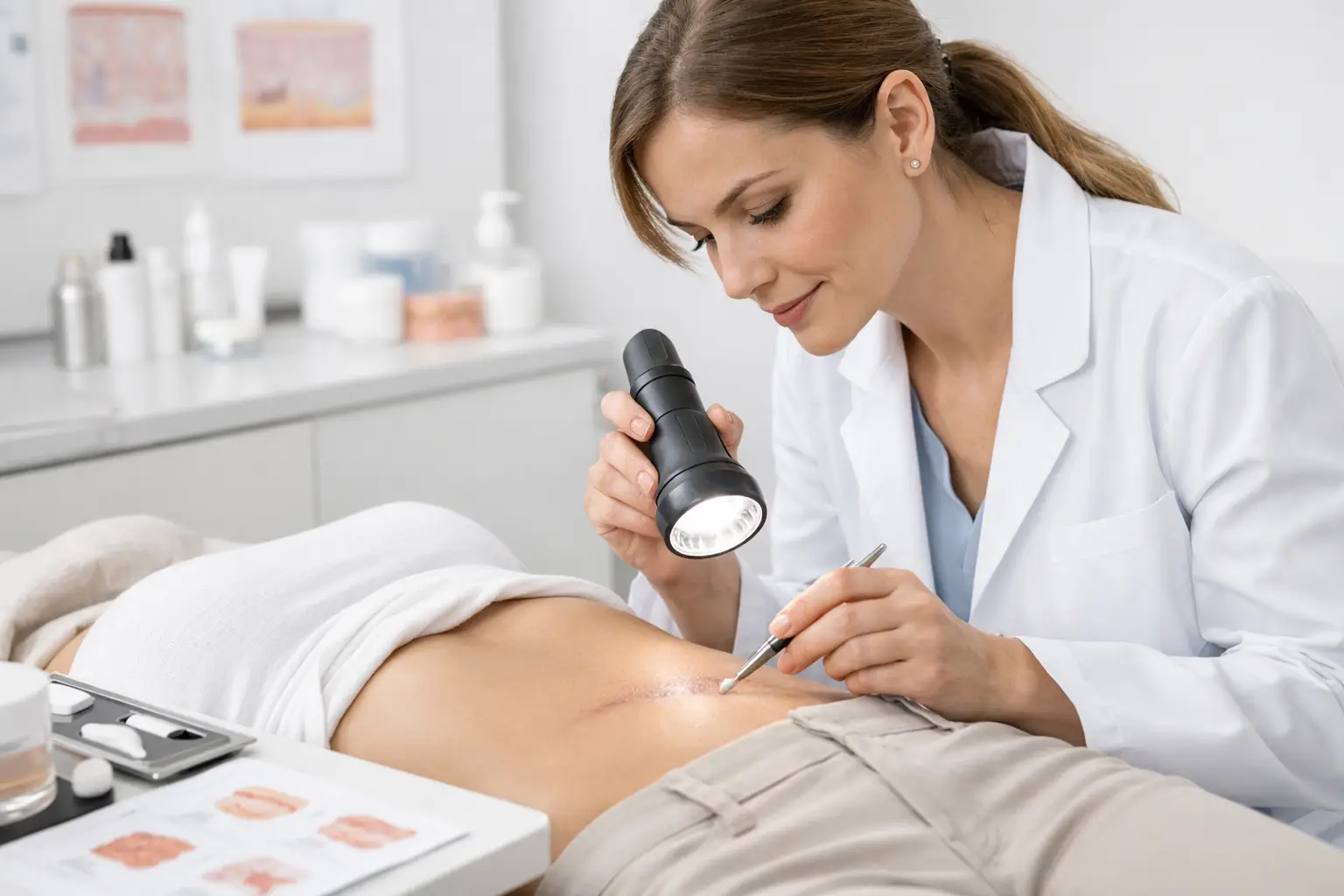
An abdominal scar blending treatment example is often more helpful than a generic promise of ‘scar camouflage’. The abdomen is a technically demanding area: skin tone can shift across the stomach, scars may be raised or indented, and movement, clothing friction and sun exposure all affect how the area heals. A successful result begins by understanding what the scar can realistically do, rather than trying to force pigment into tissue that is not ready.
Consider a client with a pale, linear lower-abdominal scar following surgery. The incision has fully closed and the client is medically healed, but the scar remains noticeably lighter than the surrounding skin. It is flat, stable and no longer red, although there is a slight change in texture along part of the line. Their goal is not to erase the scar completely. It is to reduce the contrast so the area looks less obvious in swimwear, underwear and everyday life.
What happens before abdominal scar blending treatment
The first stage is a detailed suitability assessment. A specialist practitioner considers the scar’s age, colour, shape, texture, sensitivity and stability, alongside the client’s skin tone and healing history. Surgical scars should be fully healed before camouflage tattooing is considered. For many people, that means waiting at least 12 months, but healing is individual and a longer period may be appropriate.
The practitioner also checks whether the scar is flat or raised, whether there is any ongoing inflammation, and whether it has changed recently. Keloid-prone scars, actively irritated areas, unstable skin conditions and scars still undergoing medical treatment require particular caution. In some cases, blending is not the right first treatment. A client may need more time, medical guidance or a texture-focused approach before pigment is introduced.
For this example, the scar is suitable for treatment because it is mature, flat and pale. The texture difference is minor enough that reducing colour contrast should make a meaningful visual improvement. This distinction matters: paramedical tattooing restores the appearance of colour, but it does not remove scar tissue or guarantee an invisible finish.
Mapping the natural skin tone
Abdominal skin is rarely one uniform shade. The area above the navel may differ from the lower stomach, while skin close to a surgical line can hold warmth, coolness or slight pigmentation changes. A specialist does not select a single pigment from a bottle and apply it unchanged.
Instead, the skin is assessed in natural light and several shades may be custom blended. The aim is to recreate the visual character of the surrounding skin, including its depth and undertone. A pigment that initially appears perfect can heal warmer, cooler, lighter or darker, so experienced practitioners build the result gradually.
At Ink Illusions, this type of work is approached through advanced paramedical tattooing principles, combining scar camouflage knowledge with a detailed understanding of pigment behaviour in healed skin. The treatment plan is individual because the scar, skin and desired degree of blending are individual.
Abdominal scar blending treatment example: the first session
At the first appointment, the area is cleansed, photographed for treatment records and mapped. The practitioner may work with a small test area where suitable, particularly if the client has a complex undertone or a history of unusual healing. This allows both client and practitioner to assess the healed pigment response before committing to wider coverage.
For the lower-abdominal scar in this example, pigment is implanted using controlled cosmetic tattooing techniques. The approach is soft and layered rather than dense and opaque. A heavy application may look acceptable immediately after treatment but can heal patchy or create an unnatural block of colour against the surrounding skin.
The practitioner works across the pale line and lightly feathers pigment beyond its edges. This soft diffusion is essential. The eye notices a sharp transition more readily than a subtle variation in tone, so blending beyond the scar helps prevent an outlined appearance.
The appointment is not designed to deliver a final result in one sitting. Freshly treated skin may look deeper in colour or slightly warmer than expected, then soften as it heals. Scar tissue can also retain pigment differently from normal skin. Some sections may heal beautifully after one pass, while others need careful refinement.
Healing after the first appointment
The client follows tailored aftercare to protect the treated area. This usually includes keeping it clean, avoiding friction from tight waistbands where possible, and not picking at any light flaking. Swimming, saunas, intense exercise and direct sun exposure should be avoided during the initial healing period, according to the practitioner’s instructions.
Sun protection is especially relevant for the abdomen. UV exposure can darken surrounding skin while the camouflage pigment remains stable, making a previously well-matched result appear lighter by comparison. A client who regularly sunbathes or uses tanning products should discuss this openly during consultation, as it affects both pigment selection and long-term maintenance.
At around six to eight weeks, the scar is reviewed once the skin has settled. In this example, the client sees a clear reduction in contrast. The centre of the scar has blended well, but a small section at one end has healed lighter due to denser scar tissue. This is a normal reason for a second session, not evidence that the treatment has failed.
Refining the result in later sessions
The second appointment focuses only on the areas that need adjustment. The practitioner slightly refines the custom shade and adds controlled layers through the lighter section. They may also rebalance warmth or depth across the full scar so the finish remains natural from different angles and in changing light.
Most abdominal scar camouflage cases need more than one session. Two to three sessions are common, although a larger surgical scar, a scar with mixed texture, or skin that does not retain pigment predictably may require further work. The spacing between appointments is not a delay for its own sake. It gives the skin time to reveal its true healed result before another layer is considered.
In this treatment example, the final outcome is not a magically erased surgical line. At close range, the scar can still be seen, particularly where its texture catches the light. From a normal conversational distance, however, the pale contrast is significantly reduced. The client reports feeling more comfortable wearing clothing that reveals the lower abdomen and no longer feels that the scar is the first thing they notice in the mirror.
That is the benchmark for responsible scar blending: a visible, confidence-restoring reduction in contrast that respects the skin rather than overpromising perfection.
When pigment is not the first answer
Not every abdominal scar should go straight to camouflage tattooing. An indented scar may cast a shadow even when the colour is matched, while a thick or raised scar can remain visible because of its structure. In these cases, scar revision techniques such as MCA inkless needling or radiofrequency microneedling may be considered first, where suitable, to support texture improvement before colour work.
A client with both a C-section scar and stretch marks may also benefit from a staged plan. Stretch mark camouflage and scar blending can be complementary, but they are not identical treatments. The practitioner needs to decide whether the scar and surrounding skin should be treated together or separately to achieve the most balanced result.
Skin tone is another key variable. Deep skin tones, olive undertones and highly pigmented skin can achieve excellent blending, but pigment formulation and healed-colour knowledge are critical. A generic flesh-tone pigment is not an advanced solution. The right approach is built around the client’s actual skin, not a limited shade chart.
Questions worth asking at consultation
A quality consultation should leave a client clear about suitability, likely session numbers and realistic outcomes. Ask to see healed examples of comparable scars and skin tones, rather than relying only on immediately after-treatment images. Discuss whether the scar is mature enough, whether texture work should happen first, and how sun exposure or tanning may affect the result.
It is also sensible to ask how the practitioner manages colour correction if the skin heals unexpectedly. Scar camouflage is specialist work. The treatment requires an understanding of skin anatomy, pigment theory, scar behaviour and careful machine control, not simply the ability to apply a skin-coloured tattoo.
The most valuable result is often quieter than people expect. When an abdominal scar no longer draws the eye first, clients can feel more at ease getting dressed, going on holiday or simply seeing their reflection. That change begins with a realistic plan, precise colour work and a practitioner who treats healed skin with the specialist care it deserves.