


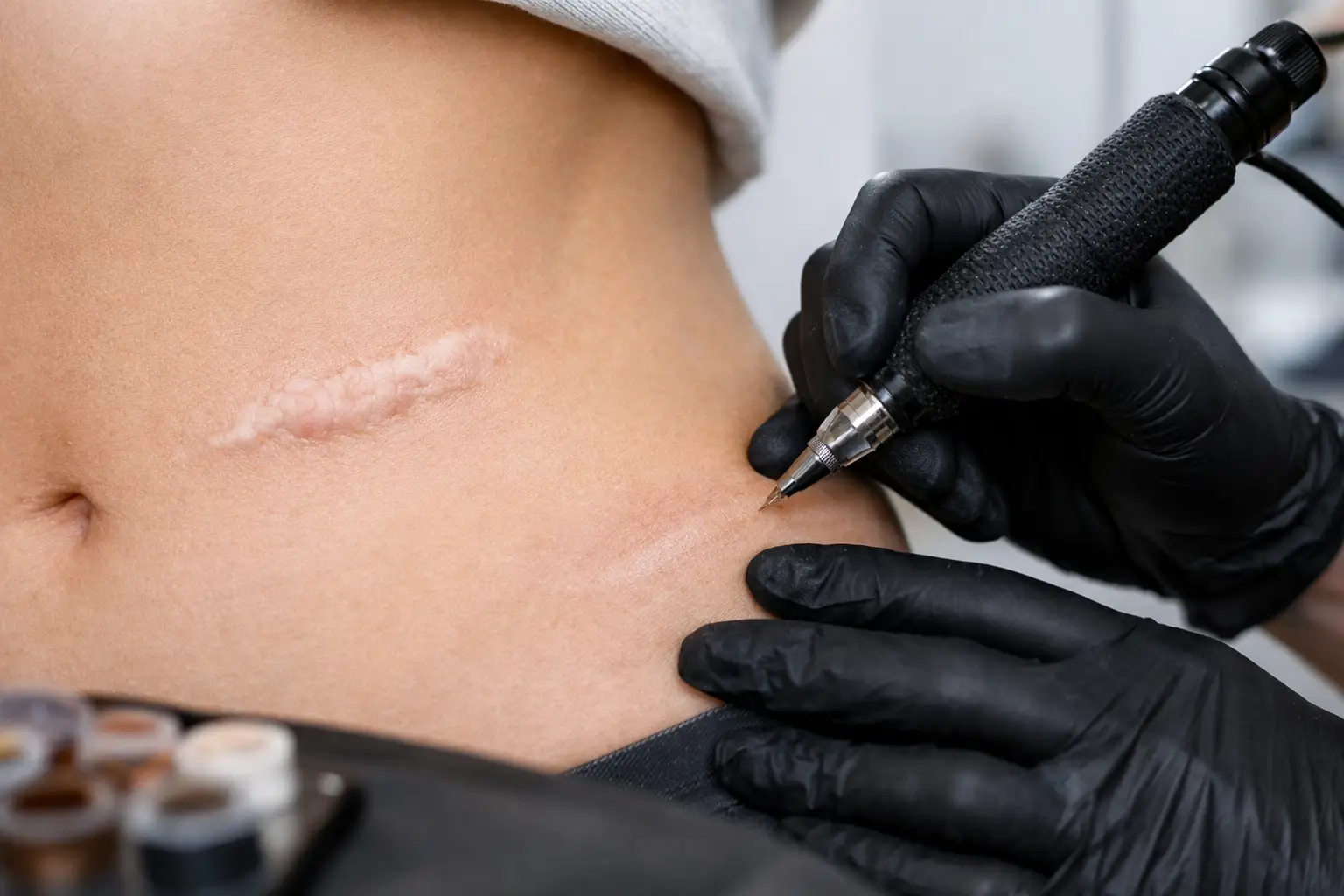
A scar can be medically healed and still feel unfinished. That is usually the point at which people start asking, what is scar camouflage tattoo, and whether it can make the area look less obvious without creating something that looks artificial.
Scar camouflage tattoo is a specialist paramedical tattoo treatment designed to reduce the visual contrast between a scar and the surrounding skin. Rather than decorating the scar, the practitioner implants carefully selected pigments into the area to help it blend more naturally with the client’s existing skin tone. When it is done well, the result is not about perfection. It is about softening visibility, restoring balance and helping skin look less disrupted.
This is not the same as a standard body tattoo, and it should never be approached as one. Scar tissue behaves differently from normal skin, holds pigment differently and needs a much more considered treatment plan. Technique, pigment choice, skin assessment and healing knowledge all matter.
What is scar camouflage tattoo and how does it work?
At its core, scar camouflage tattooing is colour correction for altered skin. The practitioner assesses the scar’s tone, texture, maturity and placement, then custom blends pigments to match the surrounding area as closely as possible. Those pigments are implanted into the scar using specialist machines and controlled depth, with the aim of reducing the pale, pink or discoloured appearance that makes the scar stand out.
The treatment works best when the main issue is colour difference rather than heavy textural change. If a scar is lighter than the surrounding skin, camouflage can often make a dramatic improvement. If it is raised, indented, ropey or very fibrous, colour work may still help, but expectations need to be managed because tattooing cannot flatten or restructure tissue on its own.
This is why experienced practitioners often combine or sequence treatments. In some cases, skin preparation such as needling, scar revision methods or regenerative treatments may be recommended before camouflage pigment is introduced. The order matters because better skin quality usually supports better pigment retention and a more refined result.
Which scars can be treated?
Scar camouflage can be suitable for a wide range of healed scars, including surgical scars, tummy tuck scars, C-section scars, breast surgery scars, injury scars, burns, self-harm scarring and some acne scarring. It can also be used in specialist areas such as areola restoration after surgery, where colour matching and symmetry are especially important.
Suitability depends less on the type of scar and more on its condition. A scar generally needs to be fully healed, stable and no longer actively changing in colour. For many clients, that means waiting at least 12 months after surgery or injury, though some scars need longer. If a scar is still red, purple, sensitive or inflamed, it is usually too early.
Skin tone is another key factor. Advanced practitioners should be able to work across a broad range of Fitzpatrick skin types, but this is where expertise becomes critical. Matching undertones in fair skin, olive skin, brown skin and deeper skin tones requires training, experience and an understanding of how pigments heal over time.
Who is a good candidate?
The best candidate is someone with a healed scar that is visually obvious because it lacks pigment or sits at a noticeably different tone from the surrounding skin. The person also needs realistic expectations. Camouflage can significantly reduce visibility, but it does not erase a scar.
A good consultation should cover medical history, scarring history, previous treatments, sun exposure habits and whether the area has been tattooed before. Some clients are ideal for immediate camouflage once healing is complete. Others will get a better outcome from preparatory treatments first.
There are also cases where treatment should be delayed or declined. Keloid-prone skin, unstable scar tissue, active skin conditions, recent isotretinoin use in some cases, pregnancy, or poorly controlled health issues may affect suitability. A responsible clinic does not push ahead simply because someone wants a quick fix.
What scar camouflage tattoo cannot do
This is where honesty matters. Scar camouflage tattoo cannot remove a scar. It cannot fully replicate natural skin structure, pores or translucency. It cannot make a thick raised scar disappear, and it cannot guarantee identical colour in every light, season or stage of healing.
Pigment can improve how a scar reads visually, especially at conversational distance, but results are influenced by texture, circulation, scar density and aftercare. If a scar catches the light because it is shiny or uneven, the eye may still notice it even when the colour match is strong.
That does not make the treatment less valuable. For many clients, reducing the scar from the first thing people notice to something that no longer dominates their attention is a major change.
The treatment process from consultation to healed result
The process begins with assessment, not treatment. A specialist should examine the scar, discuss goals and explain whether camouflage alone is appropriate or whether revision work should come first. Patch testing may be advised depending on the clinic’s protocol and the client’s history.
At the treatment appointment, the area is cleaned, assessed again in person and mapped for tone matching. Pigment is blended specifically for that client rather than selected from a basic off-the-shelf shade. The practitioner then implants the pigment gradually, monitoring how the scar tissue responds.
The appointment length varies depending on the size and complexity of the area. Smaller surgical scars may be relatively straightforward. Larger areas, such as extensive burns or broad surgical zones, require more time and a more layered approach.
Healing usually involves some temporary dryness, flaking or mild sensitivity. The colour often looks different in the first days and weeks before settling. Most clients need more than one session because scar tissue can be unpredictable, and refinement is often part of achieving the most natural finish.
How many sessions are needed?
One session is rarely the full story. Some scars take pigment beautifully, while others heal lighter, patchier or cooler than expected. That is normal for scar tissue. In many cases, two to four sessions are needed for the best cosmetic result, spaced out to allow proper healing and reassessment.
The exact number depends on the scar’s age, texture, location, size and how the immune system responds to implanted pigment. Areas with high movement or compromised tissue quality can be more challenging. A practitioner who promises a perfect one-session result on every scar is oversimplifying the treatment.
Does it hurt?
Most clients describe the sensation as manageable rather than severe, but it depends on the area and the nature of the scar. Some scars are numb in places. Others are surprisingly sensitive. Surgical areas on the torso may feel different from scars on the limbs.
Discomfort should be discussed properly beforehand, especially if the scar is associated with trauma or surgery. Good practitioners understand that treatment is not only technical. It can also be emotional, particularly for clients whose scars are tied to illness, injury or deeply personal experiences.
How long do results last?
Scar camouflage is long-lasting, but not completely static. Pigment can fade over time, and the rate varies based on sun exposure, skincare, skin regeneration, immune response and lifestyle. Some clients keep a good result for years before wanting a colour boost. Others need periodic refresh sessions sooner.
Maintenance is not a sign that the treatment failed. It is part of working with living skin. The goal is stable, natural-looking improvement, not a heavy saturated result that sits unnaturally in the tissue.
Choosing the right specialist matters
Scar camouflage sits in a category of its own. It requires more than tattoo experience and more than beauty training. The practitioner needs a working knowledge of scar biology, skin tone theory, pigment behaviour, contraindications and restorative treatment planning.
That is why specialist clinics and academy-led providers tend to stand apart. A practitioner trained specifically in paramedical work is more likely to understand when to treat, when to wait and when a combined plan will deliver a better outcome. At Ink Illusions, that standard is shaped by integrating advanced methods from Brazil, the USA and the UK into a treatment-led approach built around real scar revision outcomes.
For clients, the practical takeaway is simple. Ask to see healed results, not just fresh ones. Ask how the practitioner assesses maturity of scar tissue. Ask what happens if the scar is not ready. A serious specialist will welcome those questions.
Is scar camouflage tattoo worth it?
If a scar affects confidence, clothing choices, intimacy or how comfortable you feel in your own skin, scar camouflage can be far more than a cosmetic extra. For the right candidate, it is a precision treatment that restores visual normality in an area that has felt out of place for a long time.
The best results come from careful assessment, skilled colour matching and a practitioner who understands both the science of scar tissue and the emotional weight clients often carry into the room. If you are considering it, the smartest first step is not to ask whether any tattooist can do it. It is to ask whether your scar is genuinely ready for specialist camouflage and what approach will give it the best chance of healing beautifully.